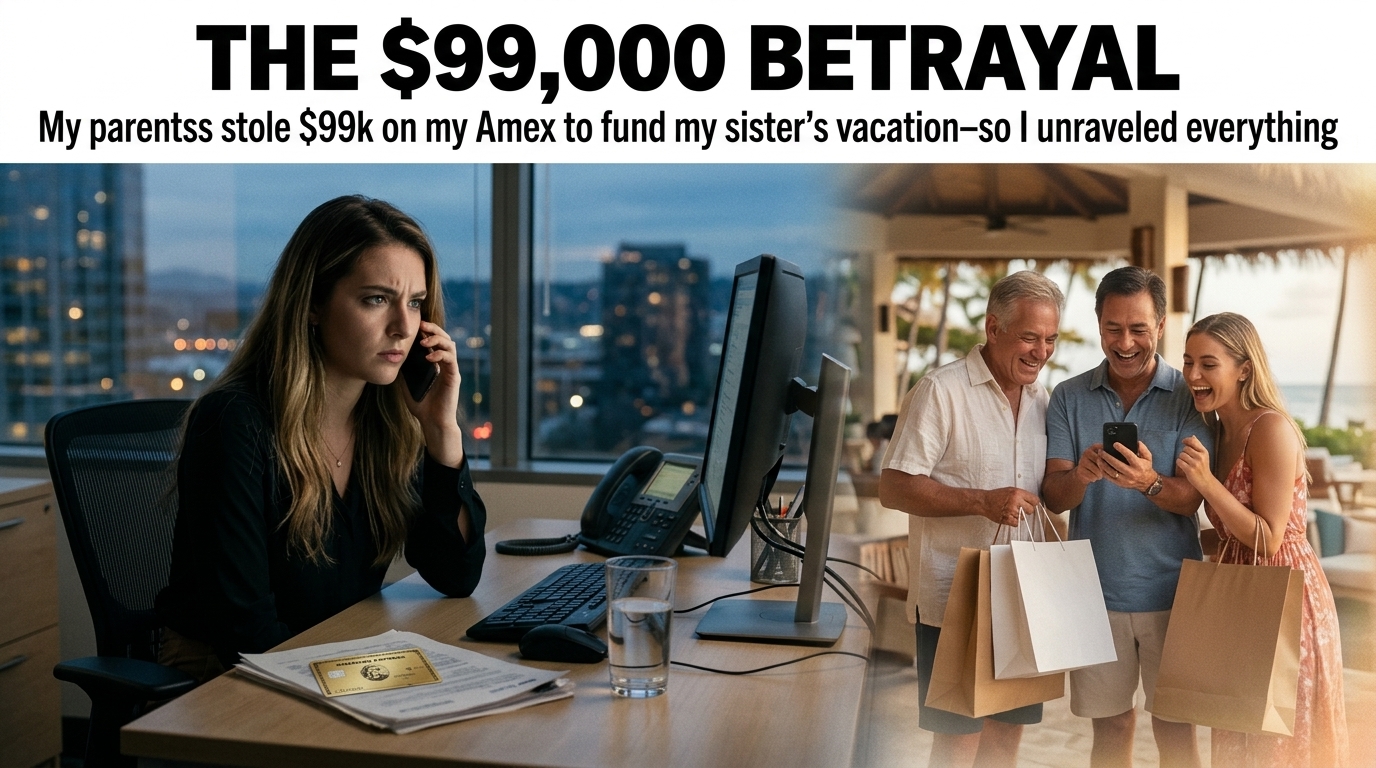
At 6:12 p.m., my mother called to celebrate stealing $99,000 from me.
She was laughing so hard I could barely hear her.
“Every dollar is gone, sweetheart. You thought you were clever hiding it? Think again.”
I stood outside my office in downtown Seattle, holding my car keys.
My sister was somewhere in Hawaii, enjoying the vacation I’d supposedly paid for.
My mother called me worthless before hanging up.
I looked at the small silver keychain in my hand and smiled.
“Don’t laugh too soon,” I whispered.
Because my family had forgotten one very important detail.
I hadn’t spent the last three years building my life without learning how to protect it.
I’m Claire Bennett. I was thirty-four, and I’d spent most of my adult life being the responsible daughter.
My younger sister, Madison, was twenty-nine.
She had expensive tastes, expensive friends, and an impressive ability to turn every inconvenience into someone else’s financial responsibility.
When she needed rent, Mom called me.
When she wanted a new car, Dad explained that family helped family.
When she lost her job, I covered her bills.
I never received much appreciation.
I received more requests.
My parents always described Madison as the sensitive one.
I was the practical one.
Apparently, being practical meant I could absorb unlimited disappointment.
I worked as a financial operations manager for a technology company in Seattle.
My apartment was modest. I drove a used Subaru, packed lunch, and kept a spreadsheet for everything.
My mother once visited and laughed at my grocery budget.
“You’re earning good money. Why live like a student?”
I didn’t explain that I was saving for a house.
I had learned that sharing good news with my family usually created new expenses.
There was one thing I kept private.
My American Express Gold card.
I’d opened it years earlier for business travel and carefully managed every payment.
The card was connected to my personal financial accounts, but the physical card stayed locked in a drawer at home.
I rarely carried it.
My mother knew about the account because she’d helped me organize paperwork after I moved apartments.
She also knew some of my old security information.
I’d changed the passwords afterward.
Or so I thought.
Three months before the Hawaii incident, Madison announced her engagement had been postponed.
She said she needed a break.
Mom suggested a family vacation.
“Something special,” she said. “We all deserve happiness.”
I declined.
I had a major project at work and couldn’t afford the time.
Madison rolled her eyes.
“Of course. Claire’s too busy being successful.”
I ignored her.
But I should have paid attention to what my mother said next.
“Don’t worry, honey. We’ll find another way.”
The first suspicious charge appeared on a Tuesday.
It was $4,850 at a luxury travel agency.
I didn’t recognize it.
I immediately opened my card account.
There were six additional transactions.
Hotel deposits. Airline tickets. Private transportation. Jewelry. Restaurant reservations.
The total was already approaching $31,000.
My fingers went cold.
I called the card issuer.
The representative confirmed the transactions were authorized through the account.
“Did you personally approve these purchases, Ms. Bennett?”
“No.”
“Do you recognize the person making them?”
I hesitated.
Then I said, “I believe I do.”
I called my mother.
She answered on the fourth ring.
“Claire! We’re busy.”
“Mom, did you use my card?”
A pause.
Then a sigh.
“Don’t start.”
“There’s almost thirty-one thousand dollars in charges.”
“Your sister needs this trip.”
I sat down.
“What?”
“Madison has been through so much. You have a good job. You can afford to help.”
“I never agreed to this.”
Mom’s voice sharpened.
“You’re always making everything difficult.”
I asked her to stop using the account.
She laughed.
“Your father said it was fine.”
That evening, I called Dad.
He didn’t deny knowing about the vacation.
He simply said, “We’ll discuss it when everyone gets back.”
I looked at the transaction list.
“There’s nothing to discuss. You used my money without permission.”
“Claire, don’t embarrass your mother.”
He hung up.
The next morning, another $12,000 appeared.
I immediately froze the card and requested a fraud investigation.
But several transactions had already been processed.
Then I discovered something worse.
Someone had accessed my online account using an old recovery method.
I changed every password, secured my email, and contacted the issuer again.
I also filed a report and began documenting every transaction.
I wasn’t going to argue with my family over the phone.
I wanted records.
And I wanted to know exactly how they had obtained access.
By Friday, the charges had reached $99,000.
I stared at the number.
Ninety-nine thousand dollars.
Money I’d saved through years of careful decisions.
Money that represented the down payment on my future home.
Madison posted photographs from Hawaii.
She was standing beside a private pool, holding a glass of sparkling water.
Her caption read:
“Finally living the life I deserve.”
Mom commented with a row of hearts.
I took screenshots.
Then I noticed something in the background of one photograph.
A printed itinerary.
The booking reference matched one of the transactions on my account.
I forwarded everything to the investigator handling my dispute.
That afternoon, my mother called.
She sounded unusually cheerful.
“Did you see your sister’s pictures?”
“Yes.”
“Beautiful, isn’t it?”
“Mom, the card issuer is investigating.”
Her laughter stopped.
“Don’t you dare ruin this vacation.”
“I didn’t authorize the charges.”
“Your father told you we’d handle it.”
“You didn’t ask me.”
She made a clicking sound with her tongue.
“You’re thirty-four years old. You have no children, no responsibilities, and plenty of money. Madison has a future to plan.”
I closed my office door.
“That’s not how permission works.”
Then she said something I’ll never forget.
“Every dollar is gone. You thought you were clever hiding it? Think again. That’s what you get, worthless girl.”
I looked at the transaction spreadsheet.
Then at the silver keychain beside my keyboard.
It was a tiny silver house.
I’d bought it the day I signed the lease on my first apartment.
My father had given me the money for the deposit.
He’d told me to keep something that reminded me I could always build a home of my own.
I hadn’t spoken to him properly in weeks.
But suddenly, I remembered a conversation from the previous month.
He’d asked whether I still used the old family email address.
I’d said no.
He’d looked relieved.
At the time, I thought it was just another strange question.
Now I wondered what he knew.
Two days later, I received a call from the card issuer’s investigation department.
They had identified suspicious account access.
The representative asked me to verify several details.
Then she said something unexpected.
“Ms. Bennett, we have identified additional activity involving an authorized user profile.”
I froze.
“Authorized user?”
“An older profile associated with your account was reactivated shortly before the transactions began.”
I asked who had reactivated it.
She couldn’t disclose everything immediately.
But she explained that the investigation had found discrepancies between the account activity and my usual spending pattern.
I requested the records.
Then I called my attorney, Rachel Morgan.
Rachel had handled a property dispute for me the previous year.
She listened without interrupting.
When I finished, she asked one question.
“Claire, did you ever give your parents access to your financial paperwork?”
“Years ago.”
“Did they have your old address?”
“Yes.”
“Then don’t contact them again until we understand the records.”
I followed her advice.
Over the next week, I provided the issuer with my travel records, employment schedule, account history, and evidence that I hadn’t been in Hawaii.
I also submitted the photographs Madison had posted.
Meanwhile, my family continued celebrating.
Madison sent me a message.
Thanks for finally doing something nice for me. You should try being generous sometime.
I didn’t respond.
Then, on Monday morning, Dad called.
His voice was different.
“Claire, are you alone?”
“Yes.”
“Your mother doesn’t know I’m calling.”
I gripped the phone.
“What happened?”
He breathed heavily.
“There’s something I need to tell you about that card.”
At 6:12 p.m. on Wednesday, my phone rang again.
Mom.
I was leaving my office in downtown Seattle.
The rain had started, and people were hurrying toward the parking garage.
I answered.
“Are you sitting down?” she asked.
I stopped walking.
“Why?”
“There’s been a terrible mistake.”
I said nothing.
She continued.
“Your father’s received some paperwork. Someone contacted him about the vacation charges.”
I leaned against the building.
“What paperwork?”
“Claire, listen. We can explain.”
For the first time, my mother sounded afraid.
I could hear Dad speaking in the background.
Then she whispered:
“They’re saying the account wasn’t supposed to be used that way.”
I closed my eyes.
“Who told you that?”
She didn’t answer.
Instead, I heard a door close.
Then Dad took the phone.
“Claire, I need you to come home this weekend.”
“Why?”
“Because your mother isn’t telling you everything.”
My knees weakened.
“What did she do?”
Dad was silent for several seconds.
Then he said, “I didn’t know she was going to take it that far.”
The following Saturday, I met my parents at their house.
Rachel came with me.
Mom sat at the dining table.
Her hands were folded around a cup of tea.
Dad stood beside the window.
For once, neither of them tried to lecture me.
Rachel placed a folder on the table.
“We have the account access records,” she said.
Mom looked away.
The evidence showed that the old authorized-user profile had been reactivated using information associated with my parents’ household.
The disputed purchases had been made through that access.
But the investigation had also uncovered something else.
A payment authorization had been prepared for an additional $18,000.
It hadn’t gone through because I’d frozen the account.
Mom stared at the document.
“I was going to pay it back.”
“With what?” I asked.
She began crying.
Dad finally sat down.
“Your mother thought she could use the money temporarily.”
I looked at him.
“And you?”
He rubbed his forehead.
“I knew about the first bookings. I thought she had spoken to you.”
“You never called to ask.”
He nodded.
Then Rachel opened another envelope.
It contained a copy of an email Dad had sent to the card issuer several days earlier.
He had reported that the account access might have been unauthorized.
Mom turned toward him.
“You promised you wouldn’t tell her!”
Dad didn’t look at her.
“I promised I wouldn’t let this destroy her.”
I stared at him.
For years, I’d believed Dad was simply passive.
He rarely defended me when Mom favored Madison.
He avoided arguments.
He disappeared into his garage whenever family gatherings became uncomfortable.
But his email showed that he’d started investigating the charges before I knew he was involved.
He had kept copies of the old account paperwork.
He had noticed that Mom was using information from a profile I’d closed years earlier.
And he had quietly contacted the issuer.
There was one more document.
A handwritten note from Dad.
Rachel handed it to me.
It said:
Claire, I should have protected your boundaries years ago. I kept telling myself that keeping peace was the same as keeping a family together. It wasn’t.
I remember giving you the money for your first apartment. You were so proud of that little place. I didn’t want you to lose the future you’ve worked for because we failed to respect what belonged to you.
I had to put the paper down.
My father had never been good with words.
But he’d remembered the apartment.
He’d remembered the little silver house keychain.
And he’d finally chosen to stand beside me.
The consequences came over the following months.
The card issuer completed its investigation and reversed the disputed charges that qualified under its fraud process.
The remaining transactions were handled through the formal dispute and recovery process.
My parents were required to provide records and cooperate with the investigation.
Mom eventually admitted she had arranged the vacation purchases without my consent.
She and Dad agreed to repay any amounts that were not recovered.
The family relationship changed permanently.
Madison was furious when she learned the vacation would no longer be funded by my account.
She called me selfish.
I didn’t argue.
I simply told her that she could arrange her own holidays from then on.
My mother later sent an apology.
It was three sentences long.
I read it once and put it away.
I didn’t immediately forgive her.
I didn’t have to.
Dad was different.
He began visiting my apartment on Sunday afternoons.
Sometimes he brought groceries.
Sometimes he fixed something that wasn’t broken.
He never asked for money.
One afternoon, he brought an old photograph from my first apartment.
I was standing outside the building, holding a cardboard box.
My father was beside me, smiling.
On the back, he’d written the date.
Underneath it were five words:
She built this herself. Proud.
I looked at him.
“You kept this?”
He nodded.
“I kept everything from that day.”
My throat tightened.
For years, I’d thought my father hadn’t noticed how often I was overlooked.
Apparently, he’d noticed more than I realized.
He just hadn’t known how to say it.
That evening, after he left, I placed the photograph beside my little silver house keychain.
Outside, Seattle rain tapped gently against the window.
My family had taken $99,000 because they believed I would always pay to keep everyone happy.
They had mistaken my silence for permission.
I turned off the kitchen light.
And for the first time, the little silver house on my keys felt less like a reminder of what I’d lost.
It felt like proof of what nobody could take away.
Leave a Reply